

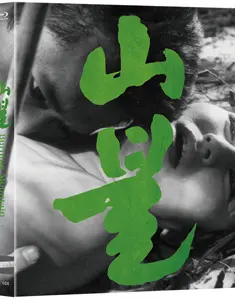

Blu-ray Collection
Burning Mountain(1967)
Burning Mountain is the 25th Blu-ray title planned by The Korean Film Archive and produced by Blue Kino. Based on the play of the same title by Cha Bum-seok, Burning Mountain is a masterpiece that superbly portrays the tragedy of war and human desire, set during the Korean War in a town where all the men have been conscripted and only the women remain. It won Best Film, Best Actress (Ju Jeung-nyeo) and Best Screenplay at the Blue Dragon Film Awards in 1967.
This is a unique film that combines the tragic history of the Korean War and sexual desire, and it attracted attention for this particular element of the subject.The part in the film that did not draw so much attention was ultimately the tolerance toward people, manners, and the female community spirit going beyond desire. Sa-wol (Do Kum-bong) is described as a typical wicked woman as she threatens Gyu-bok (Shin Young-kyun) and Jeom-rye (Ju Jeung-nyeo) and sexually exploits him in order to satisfy her sexual desire, but as the film progresses toward the latter half, she shows a sense of repentance, sympathy and compassion for the man she blackmails into having sexwith her. This gives the film more resonance with its tragic ending. The three-dimensional female characters, who do not give up ordinary human desires and emotions but embrace each other beyond the ideological conflict at a critical moment, demonstrates well the female community, which was not apparent in any other films made during this period.
During this time, Kim Soo-yong concentrated on poetic films and cinematic modernism, and Burning Mountain is the main text in which such experimental nature can be found. Beginning with the unconventional experimental idea of characters speaking to the camera (the North Korean guerillas behind the camera), the film fills the emptiness thanks to minimal dialogue with a sense of rhythm through camera movement and editing. In particular, the initial scene, in which darkness and light are in contrast, created by a camera moving around the bamboo grove while following a character, is one of the most beautiful scenes in the history of Korean cinema. Kim Soo-yong’s excellence lies in the smooth coexistence of such experimentswith style, narrative, characters, and message. Burning Mountain can be regarded as an example of the masterful sense of a prolific director, trained through making a large body of work, leading to a high-quality film.
The commentary was done exclusively by film critic, Jung Sung-il. His commentary is special as always, arguing in great detail and creatively as to why Burning Mountain is remarkable, and why Kim Soo-yong should be re-x-evaluated now throughout the entire running time. Film critic Kim Young-jin’s explanation included in the booklet will be a guide to understanding Kim Soo-yong’s cinematic world and the critical meanings of BurningMountain.
The Blu-ray footage was sourced from the outcome (2K) of intensified restoration, processed through two phases in 2012 and 2021 by the Korean Film Archive. It will allow the viewer toenjoy properly the great cinematography of this 1960s black-and white film, which has been reborn through restoration.
Subtitles: Korean, English, and Japanese
Screen: 1080P FULL HD 16:9
Audio: Korean LPCM Mono
Black & White
Rated 15: Ages over 15 admitted.
Special Features
- Commentary: Chung Sung-il(Film Director, Film Critic)
- Digital Restoration: Before & After
Booklet
- “Burning Mountain: Securing the Representative Status of Literary Films with a Modern Approach.” Kim Young-jin(Film Critic)
Miscellaneous
- Three Film Postcards