

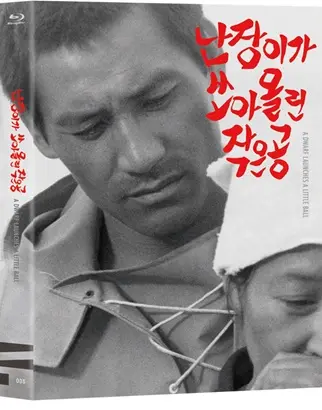

Blu-ray Collection
A Dwarf Launches a Little Ball(1981)
A Dwarf Launces a Little Ball is the 35th Blu-ray title planned by the Korean Film Archive and produced by Blue Kino.
Although the film is considered to be both Lee Won-se’s signature film and a representative work of Korean cinema, it is true that it has not been discussed as much as it deserves. Perhaps this is because it was overshadowed by the huge influence of the original novel, and because Lee Won-se's profile was not as prominent as those of other great directors. Most of all, it is largely due to the (disparaging) preconceived notion that the film was ruined by censorship, and that the ensuing version did not properly embody what it should have done. As a result, it has become a forgotten masterpiece that lives on in the title, but one that few people have seen.
It is undeniable that the film was heavily censored during the script stage, and that this had a significant impact on the overall cinematic perspective and tone of the current version. In the censorship documents of the film, which is now preserved at the Korean Film Archive, there remains a record that the film was revised three times. Through these three rounds of censorship, the initial setting of the film and the final screenplay were drastically changed. Firstly, the setting was changed from unauthorized houses in the city to salt farms, and the critical view on the 1970s housing administration and society was devitalized, so the film was modified into a family-centered story. In addition to this, the labor issues shown in two scenes were removed and the cause of the father's (Kim Bul-i) suicide was changed into a mental disorder. As a result, the socially critical messages were weakened and the image of a warm family living in poverty, but not being servile, was given more emphasis.
As a result, the film shows the tragedy of the eviction of those who simply wanted to keep the home where they have lived without fault of their part, and without much resistance. The film does not elaborate on how tragic this expulsion is, but it does show how much they had become part of their home. It conveys cinematically that their lives and existence were already so deeply entrenched in that space that to uproot them would be to deny their very existence. The cinematic attitude was partly the consequence of censorship and partly the result of Lee Won-se’s humanistic and romantic view. Therefore, A Dwarf Launces a Little Ball remains a film that embodies humanistic reality, which is somewhat distant from the critical realism pursued by contemporary auteurs, and today, this point has become a strength that shows the characteristic traits of both the film and of director Lee Won-se.
The film’s director, Lee Won-se, was born in Pyeongwon-gun, Pyeongannam-do in April 1940. He came from a Christian landowning family. In 1946, when he was six years old, his family fled to South Korea to escape the communist regime. His family settled on a Gunja Salt Farm in Siheung, Gyeonggi-do, where they already had acquaintances, so the beauty of the salt farm and the hard labor of the workers there were strongly imprinted on Lee Won-se as a child. This memory is repeatedly represented in his films, including A Dwarf Launches a Little Ball (1981). He started his career in the film industry as an assistant director to director, Kim Soo-yong, in 1960, and he worked for about 10 years as a talented assistant supporting Kim Soo-yong's cinematic career. In 1971, he finally made his directorial debut with The Lost Season, and went on to direct a total of 34 films over a period of 15 years. Including The Flower and The Snake (1975), The World without Mom (1977), and Queen Bee (1985). Lee Won-se is a director with a unique cinematic world, which combines with experimental spirit and humanism, and is one of the auteurs, who should be rediscovered in Korean cinema history.
The supplements of this Blu-ray include an edited version of an oral interview video with the late director Lee Won-se’s recollection of A Dwarf Launches a Little Ball, conducted by the Korean Film Archive in 2017. This approximately 20-minute video clip contains a variety of behind-the-scenes stories about the film that he never told in any other interview and his directorial perspective on the film. Commentary by director and film critic, Jeong Sung-il, brings a whole new perspective to the film. The images of the Blu-ray have been sourced from the outcome, restored in 4K in 2023 by the archive, and the version restored in UHD will make the film’s value even more apparent.
The film’s director, Lee Won-se, was born in Pyeongwon-gun, Pyeongannam-do in April 1940. He came from a Christian landowning family. In 1946, when he was six years old, his family fled to South Korea to escape the communist regime. His family settled on a Gunja Salt Farm in Siheung, Gyeonggi-do, where they already had acquaintances, so the beauty of the salt farm and the hard labor of the workers there were strongly imprinted on Lee Won-se as a child. This memory is repeatedly represented in his films, including A Dwarf Launches a Little Ball (1981). He started his career in the film industry as an assistant director to director, Kim Soo-yong, in 1960, and he worked for about 10 years as a talented assistant supporting Kim Soo-yong's cinematic career. In 1971, he finally made his directorial debut with The Lost Season, and went on to direct a total of 34 films over a period of 15 years. Including The Flower and The Snake (1975), The World without Mom (1977), and Queen Bee (1985). Lee Won-se is a director with a unique cinematic world, which combines with experimental spirit and humanism, and is one of the auteurs, who should be rediscovered in Korean cinema history.
Special Features
- Commentary by Chung Sung-ill(Film Critic, Director)
- Lee Won-se on A Dwarf launches a Little Ball
- Digital Restoration : Before & After
- Image Gallery
Booklet
- Blu-ray Restoration Note: A Dwarf Launces a Little Ball(1981), The Digital Restoration Team at The Korean Film Archive
- Lee Won-se: Perhaps The Most Experimental Director in Korean Cinema History, Cho Jun-hyoung(Senior Researcher, Korean Film Archive)
- The Complex Encounter between Government Censorship and Authorship, Cho Jun-hyoung