

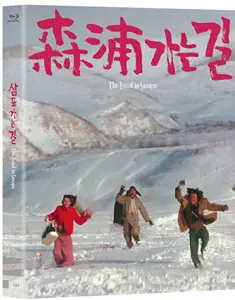

Blu-ray Collection
The Road to Sampo(1975)
The Road to Sampo is the 24th Blu-ray title planned by the Korean Film Archive and produced by Blue Kino. Based on the novel of the same name by Hwang Sok-yong, The Road to Sampo is special as it is a posthumous work by Lee Man-hee, one of the most renowned film auteurs of Korean cinema. He collapsed while editing this film on April 3 1975, and died on April 13. The film was edited by the production company and released in the Kukdo Cinema, and went on to win 7 awards, which included Best Film, Best Director, Best Cinematography, and Best Supporting Actor at the Grand Bell Awards in 1975.
The Road to Sampo is a road movie and is therefore something of a rarity in the Korean cinema history. Road movies have distinctive features such as accidental events and meetings occurring in the path of characters’ lives, and the characters maturing through this process, which is unlike typical genre films based on solidly pre-structured plots and characters. With the portrayal of an arduous journey of three working class people: a bar hostess Baek-hwa (Moon Sook), Jeong (Kim Jin-kyu), who was recently released having spent 10 years behind bars, and construction worker, Young-dal (Baek Il-seob), who wanders from one construction site to another, this film has typical features of a road movie. They meet by chance on a mountain road in Gangwon Province and travel together. Their journey on a Gangwon Province mountain path in the middle of winter is grueling, but through this journey, they understand, look after and learn to love one another, before finally going their separate ways. The Road to Sampo carefully embraces their life stories and delivers them to the audience. Such warm attention given to working class people, our neighbors is one of the prominent features of Lee Man-hee’s films. On the other hand, Lee carried out various cinematic experiments within the typically simple and loose structure of road movie, which were done neither for the sake of experiment itself, nor for mere novelty value. This makes viewers feel cinematic moments beyond the simple story, leaving an unidentifiable lingering resonance even after the end of the film, which is perhaps why The Road to Sampo is more than just an ordinary popular film of the time.
Film critic Chung Sung-il’s commentary is special, as always. Examining every detail of the film throughout the running time, he provides meticulous, detailed and original comments on why The Road to Sampo is extraordinary and the significance director Lee Man-hee has for us today. As well as the commentary, in the booklet there is a review by Professor Han Nam-hee from The City University of New York exploring the cinematic experimentation in The Road to Sampo and its meaning from a film scholar’s perspective. These two explanations present new perspectives on the film. A special interview with actor Moon Sook, who played one of the protagonists, is also included in the Blu-ray.
From her, the viewers can hear interesting episodes related to the film and Lee’s directing style, as well as the process she used to develop her character. In particular, it is very intriguing to hear her testimony that Lee didn’t want to include the last scene in the film until right at the very end. Viewers can explore further depth and meaning of the film through these supplements.
Subtitles: Korean, English, and Japanese
Screen: 1080P FULL HD 16:9
Audio: Korean LPCM Mono
Rated 15: Ages over 15 admitted.
Special Features
- Commentary: Chung Sung-il(Film Director, Film Critic)
- Image gallery
- Digital Restoration: Before & After
- Moon Sook Interview
Booklet
- “The Road to Sampo (1975): The Wandering Eye” Han Nam-hee(Assistant Professor, Queens College, The City University of New York)
Miscellaneous
- Three Film Postcards