

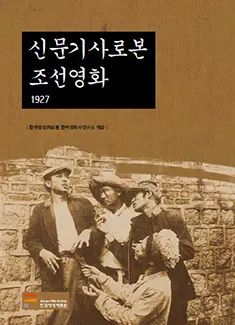

Japanese Colonial Era Movie Data Series
Joseon Films in Newspaper Articles in 1927
As the eighth publication in the series of "Korean Films through News Articles" that records and organizes news articles and advertisements on movies and entertainment in the newspapers under the Japanese colonial rule, this book covers various articles and advertisement on movies and entertainment in Maeil Sinbo, Chosun Ilbo, Dong-a Ilbo, and Jungeo Ilbo in 1927.
Korean Film: Reigns the Golden Days
The year 1927 was the time of tremendous increase in Korean film production after the success of Arirang. In 1927, 14 movies were produced including The Field Mouse, The Golden Fish, and When the Sun Rises which was a twice more produced than that in 1926. Along with this is a dramatic increase in the number of film production companies including Na Un-kyoo Production, Geumgang Kinema, Chosun Film and Arts Association, and Seogwang Kinema. Among these, Chosun Kinema Production showed the most successful production records. After a huge success with Nongjungjo, Arirang, and A Soldier of Fortune in 1926, Chosun Kinema Production produced The Field Mouse and The Golden Fish in the next year. However, An Ox without Horn became the last film produced by Chosun Kinema Production since Na Un-kyoo and Lee Gyeong-son left the company due to disagreements with the manager. After leaving the company, Na Un-kyoo and Lee Gyeong-son founded Na Un-kyoo Production sponsored by Park Seungpil, the business owner of DanSungSa, and produced Farewell.
Established Korean Distributor of Foreign Films
The year 1927 was a transitional era of foreign film distribution. It all started in May 1927 with the foundation of Gisin Corporation (Gisinyanghaeng), the exclusive foreign film distributor managed by Korean. In those days, foreign films were mostly distributed by westerners after screening first in Japan and re-importing to Korea. So, the movies were not in good condition by the time they were about to play in Korea. Besides, there were often illegal copies of those due to insufficient supply. Therefore, Gisin Corp. could not be more welcomed, given the circumstances. Starting with the special contract with Metro-Goldwyn-Mayer Studios Inc. (MGM), Gisin Corp. concluded a contract with Paramount Pictures, United Artists Corporation (UA) and other smaller companies in August of that year. Deogyeong Store (Deogyeongsanghoe), a Japanese-run company, became a Seoul agency of Dongsuh Film Corporation of Japan and distributed movies by Warner Bros., Film Booking Offices of America (FBO Pictures Corporation), and others to Seoul. Through Gisin Corp. and Deogyeong Store, foreign film distribution in Korea became systematized and provided a starting point to the growth of film culture in Korea.
Research Planning and Implementation: Jo Junhyeong (Director of Korean Movie History Research Institute at Korean Film Archive)
Co-researchers: Choe Eunsuk, Jo Oesuk, Lee Gwanguk, Lee Juyeong
Co-researchers: Choe Eunsuk, Jo Oesuk, Lee Gwanguk, Lee Juyeong
Preface
Remarks
News Article in 1927
List (articles, theaters, film studios, organizations, names of people)
Remarks
News Article in 1927
List (articles, theaters, film studios, organizations, names of people)