

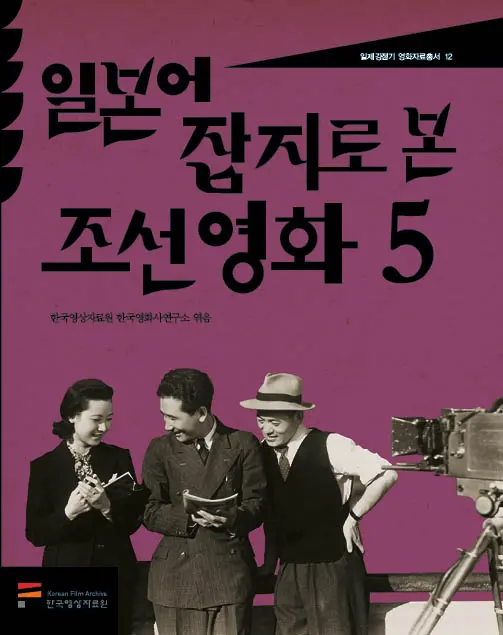

Japanese Colonial Era Movie Data Series
Joseon Films in Japanese Magazine, vol. 5
The fifth volume of the series『Korean Movies featured on Japanese Magazines』which was published in 2010. In the past, the Korean Film Archive published one edition of translated articles about Korean movies from six different magazines including 《International Movie Newspaper》, two editions from three different magazines including 《Kinema Sunbo》, three editions of articles from 1941~42 of 《Movie Subo》, and four editions about articles from 《Movie Sunbo》 of 1943, including “Korean Movie Edition” published on July 11, 1943. These five books also focused on articles from 《Movie Sunbo》 which was the most representative magazine at the end of the Colonial period. These are materials that revealed the reality of movie policies during Colonial period from “Corporation Film Distribution Staff Training Speech” (“Film Speech” hereafter). In the Korean Film Museum, a booklet titled『The First Edition of Corporate Film Distribution Staff Training Speech』is displayed. The above-mentioned five books are based on “Film Speech” Instead of an officially published book, it is a rather thin document amounting to about 86 pages for staff training purposes, but the interesting fact is that the owner of the document was Sung Dong-ho, a popular narrator of Korean films during the Colonial period. He worked in the Japanese propaganda movie industry after applying to the Korean Film Distribution Corporation, which was established on May 1, 1942. The fact that “Film Speech” exists in two different versions proves that the Korean film industry was strongly linked to the Japanese movie system. In order to unify movie distribution, people from Japan established a corporate film distribution on February 6, 1942 and started working on it on April 1. From around June of the same year, it established a facility to train staff for 3 months, and people from the information bureau, the Ministry of Foreign Affairs, university professors, and renowned movie directors gave lectures. “Film Speech,” which recorded these lectures, was published starting in September 1942 and was published as a training document afterward. In other words, the Japanese training document was also given to Korean film employees. Therefore, “Film Speech” can be thought of as containing important information including on the relationship between the Korean cinema industry and the Japanese movie industry. It explains the principles of overall stages of movies from production to censorship, distribution and release, and also includes the macroscopic framework of Japan’s “cinematic new order” and actual movie administration-related materials. Moreover, it also introduces the importance of a drama functioning as a literary movie and a news movie, as well as entertainment. On the other hand, the booklet also introduces the Japanese role models at that time, details German and Italian movie structures, and explains cinema science and film techniques in detail. It can be said that it introduces the concepts and principles of Japanese propaganda movies in general. This fifth edition, which will be the last document containing materials from 《Movie Sunbo>, is expected to continue to be the number one reference in terms of movie research during the Colonial period. It is expected to draw attention from researchers based on the fact that it also contains articles from “Cinematic New Order Journal” and “One-year Anniversary of Cinematic New Order.”
. Planning and Editing: Jung Jong-hwa (Korean Film Archive Collection head of department)
. Translation: Yang In-sil (professor of Humanities and Social Sciences at Iwate University)
. Translation: Yang In-sil (professor of Humanities and Social Sciences at Iwate University)
Table of contents / Publisher / Introduction / Explanatory remarks / 『Movie Sunbo』in 1942 / 『Movie Sunbo』in 1943
Bibliography: Movie policies from control and management perspectives (Yang In-sil) / Appendix: Article list
Bibliography: Movie policies from control and management perspectives (Yang In-sil) / Appendix: Article list