

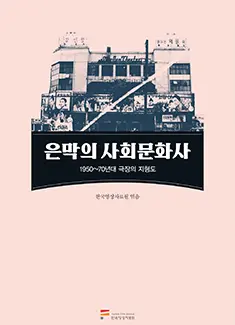

Monograph
The Cultural History of the Silver Screen: Geography of the 1950-1970s Theaters
Before transforming into multiplex where people can enjoy a movie of their choice and shopping all together at one place, theater used to be a space for films, lectures, ceremony, government functions, performances, and so on. Only after 1956 when the Korean movie industry rapidly grew and managed to distribute movies stably, cinemas finally started to settle as a place for movie screening exclusively. These theaters introduced the newest projectors, screens, and sound systems, and provided designated seats and a lounge for audiences for their comfortable experience. When necessary, a new building was built, or the existing one was remodeled. These change of cinema from a place for simply watching movies to a place for "enjoying" them led the establishment of exclusive theaters screening foreign films and Korean films separately depending on characteristics of local environment and audiences. Furthermore, a type of theater was subdivided into a first-run, second-run, and multi-run theaters, satisfying audiences in various groups. As a result, these changes formed a first model of Korean theater even before multiplex became the mainstream in 2000, and provided people with a new experience of enjoying movies in the specialized and comfortable environment. The recent publication by the Korean Film Archive, "The Cultural History of the Silver Screen" examines the changes of theater facility and scale in Seoul between 1950s and 1970s, and the new forms of the movie experience arising from it, unique screening customs, the establishment and expansion of permanent theaters in regional areas, and many others through various data.
Contained in this book are six chapters of the story that starts with Lee Gilseong's exhaustive discussion on the geography of theaters in Seoul in the 1950s and their transformation through empirical data. Lee Gil-the investigates how the number of theater increased or decreased in the 1950s by examining the states of theaters in Seoul post-Korean war, and considers the changes of its scale and facility in relation with both the film industry environment and institutional changes. In the second chapter, Lee Ji-yun analyzes the changes in the number of seats, projectors, screens, and sound systems in theaters in Seoul during the mid-1950s and the view of the film industry on these changes while concluding that the desire to generalize the Korean film industry in the global market is reflected in the modernization of theaters. Park Seon-yeong focuses on the screening stage greetings of Hyperbolae of Youth starred by Yang Seok-cheon and Yang Hun, "a dry-bones and a fatty" the top radio stars in the mid-1950s and examines how the theaters in the late 1950's planned their film screening to meet the audiences' demand. Park also reviews the roles of these actors who had demonstrated their identity as a comedian by performing both on the screen and the stage.
"The Cultural History of the Silver Screen" examines the technological characteristics of movies as well as screening practice and system and studies theaters in Seoul and regional areas, expanding the field of film studies. By publishing "The Cultural History of the Silver Screen," Korean Film Archive encourages in-depth studies and active discussion on theaters in the future.
Lee Gil-seong (Academic Research Professor, Institute for East Asian Studies at Sungkonghae University)
Lee Ji-yun (Researcher, Korean Film Archive)
Park Seon-yeong (research professor at Korea University)
Jeong Chan-Cheol (Research Professor, Contemporary Cinema Research Institution at Hanyang University)
Wee Gyeong-hae (Academic Research Professor, Institute of Humanities at Soonchunhyang University)
Song Young-Ae (Professor of Drama and Cinema at Seoul University)
Preface
A Study on the Transition of Theaters in the 1950s and the Aspect of their Specialization - Lee Gil-seong
The Desire toward Generalization of Korean Film in the World that is Reflected the Changes and the Space of Theaters in Seoul during the Mid-1950s - Lee Ji-yun
Film Screening Practice between the Late 1950s and Early 1960s: with a focus on live performances and stage greetings - Park Seon-yeong
Immersive Storytelling of Korean CinemaScope Films in the 1960s - Jeong Chan-Cheol
Historicity of Local Movie Theaters in South Korea in the 1960s - Wee Gyeong-Hae
Changes of First-Run Theaters in Seoul in the 1960s and 1970s: Focused on DanSungSa - Song Young-Ae