

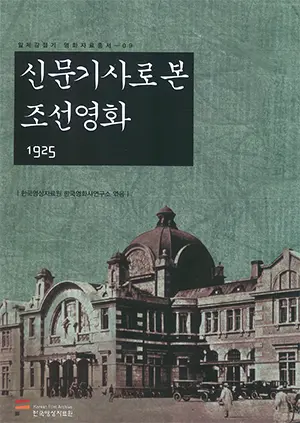

Joseon Films in Newspaper Articles in 1925
The ninth volume of the “Japanese Colonial Era Movie Data Series,” which selected and organized movie, play, and entertainment-related articles published in the Chosun colony in the 36 years of the Japanese Colonial Era, as well as the sixth volume of the “Chosun Movies as Seen through Newspaper Articles” series, contain all movie and entertainment-related articles published in the Maeil Sinbo, Chosun Ilbo, Dong-A Ilbo, and Sidae Ilbo in 1925.
Chosun’s film production kicked into high gear after the first film drama was released in 1923. There were only three movies showing in 1924, but this increased to seven movies in 1925: “Mistress Relation” (“Chongheui-ui yeon”) (“The Story of Woon-yeong” (“Un-yeongjeon”)) (Yun Baek-nam), “God’s Disguise” (Shin-ui jang) (Wang Pil-ryeol), “A Hero in a Small Village” (“Chon-ui yeong-ung”) (Yun Baek-nam), “The Story of Shim Cheong” (“Sim cheongjeon”) (Lee Gyeong-son), “The Story of Heungbu and Nolbu” (“Heungbu Nolbu-jeon”) (Kim Jo-seong), “The Pioneer” (“Gaecheogja”) (Lee Gyong-son) and “The Twin Jade Pavilion” (“Ssang-oglu”) (Lee Gu-yeong). “The Pioneer,” based on Yi Kwang-su’s novel, is recorded as the first literary movie, and Na Un-kyoo, who just entered the movie industry, started to gain recognition through his supporting role in “The Story of Woon-yeong” (“Un-yeongjeon”). As movie production thrived, incidents and accidents occurred. “Ahm Gwang” (“Amgwang”) was banned from screening by the Japanese Government-General of Korea and was re-released with the title “God’s Disguise” (“Shin-ui jang”), but failed to be a box-office hit. Moreover, the anecdote where Dansungsa, which received permission to film “Shimcheongjeon” from the Japanese Government-General of Korea, sued Baeknam Production, which already filmed a movie titled “The Story of Shim Cheong” (“Sim Cheongjeon”) that was in the production completion stage, was recorded as the first incident between Korean movie production companies. The present book includes fruitful stories of the production and release of these movies at the forefront of the history of Chosun-Korean movies. The book also contains an abundance of articles introducing Hollywood movies and articles related to censorship and the policies of the Japanese Government-General of Korea.
- Co-researchers: Choi Eun-suk (visiting scholar, Korean Federation of Film Archives), Cho Oe-suk (visiting scholar, Korean Federation of Film Archives)
Introductory Remarks
Publication Remarks
1925 Newspaper Articles
Index of Articles
Names
Troupes and Organizations
Theaters