

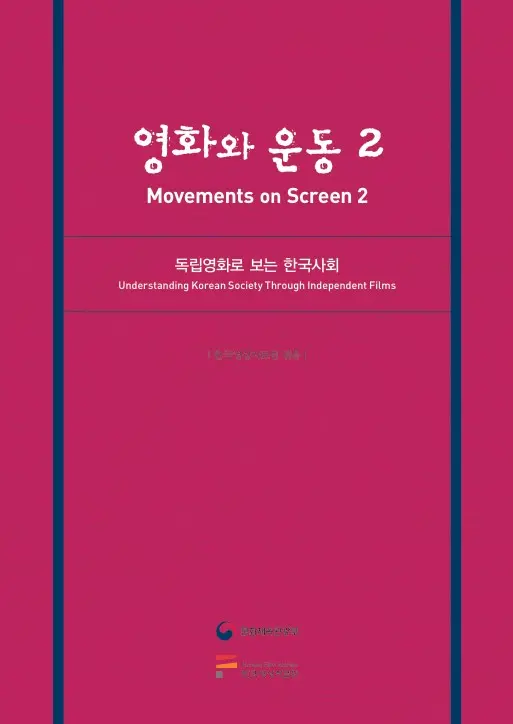

Multilingual-subtitle DVD Collection
Booklet: Movements on Screen 2
This DVD box set of Movments on Screen 2 is a product of a nonprofit collaboration between the Ministry of Culture, Sports, and Tourism, and Korean Film Archive. We hope this project helps overseas’ audiences to develop a richer understanding of Korean society and culture through Korean films. This project selects one theme each year, produces DVD sets with subtitles in seven languages, and distributes them free of charge to overseas diplomatic stations and research centers.Our goal is to increase the interest and understanding of enthusiasts and researchers alike regarding Korean culture, society, and history.
This year marks the 100th anniversary of the beginning of Korean cinema’s journey. The film, first introduced to Joseon, the precursor to modern day Korea, was considered a modern-day spectacle. It evolved in association with the nationalist movement that rose up in opposition to Japanese colonial rule of Joseon. After liberation, Korean films have been shaped into their current form through various artistic and social movements. Since the 1980s, many films have categorized themselves as independent to differentiate themselves from major commercial films. The independent film scene and politics have continuously fed off each other through various movements, including democratization, the labor movement, and feminism. Thus it would be fair to say that Korean cinema has moved dynamically in response to historical upheavals along its century-old journey.
In this context, this year’s theme is “Movement on Screen” in following last year’s theme. While the films we introduced to you last year were produced during the 1980s and 1990s, this year’s selection includes films produced since 2000: The Past Is a Strange Country (dir. KIM Eung-su, 2007), Stayed out Overnight (dir. KIM Mirye, 2009), Two Doors (dir. KIM Il-ran & HONG Ji-yu, 2011), and Troublers (dir. LEE Young, 2015). The adoption of new digital technologies has opened up new approaches for these filmmakers who have been led to ponder new methods of production and distribution. Their films also reflect broader media movements. They discuss the unmourned past and the problematic present and focus on the subjects who have traditionally not received much attention, such as women, nonstandard workers, and sexual minorities. The attitudes they project reflect contemporary Korean social movements. It is such a shame that we can include only four films out of the many outstanding films produced since 2000. Nonetheless, I hope that these four films will foster interest in and understanding of Korean society and film.
SHIN Eun-shil
Executive Committe Member of Seoul Independent Documentary Film & Video Festival
BYEON Seong-chan
Film Critic
HWANG Miyojo
Film Study Researcher
MAENG Soo-jin
Film Critic
JEONG Ji-hye
Film Critic
Executive Committe Member of Seoul Independent Documentary Film & Video Festival
BYEON Seong-chan
Film Critic
HWANG Miyojo
Film Study Researcher
MAENG Soo-jin
Film Critic
JEONG Ji-hye
Film Critic
Greetings 5
Introduction 131
The Past Is a Strange Country 147
Stayed Out Overnight 171
Two Doors 203
Troublers 231
Introduction 131
The Past Is a Strange Country 147
Stayed Out Overnight 171
Two Doors 203
Troublers 231